
This Is Not the MBA Your Seniors Studied—Here’s What’s Really Changing

Remember when an MBA was all about thick textbooks, case studies, endless PowerPoint presentations and formal suits? That version of the MBA doesn’t exist anymore!
In recent years, the MBA has undergone a massive transformation driven by technology, shaped by shifting industry demands and tailored to the modern workforce for a tech-driven world.
Artificial Intelligence now sits at the centre of every business sector, prompting business schools to rethink how they prepare future leaders. In response, institutions are redesigning their MBA programmes to keep pace with technological advancements and evolving workforce needs for the digital era.
According to the Graduate Business Curriculum Summary Report 2025, AI is a significant pillar of graduate business education. Jeff Bieganek, Executive Director of the Roundtable, explains:
“B-Schools are not only retaining disciplinary rigour but are intentionally linking it to leadership, ethics and analytics skills needed to lead in today’s business environment.”
Now, it’s time to look beyond glossy brochures and outdated MBA subject lists. The modern MBA is designed for a different world- digitally fluent, ethically grounded and deeply aligned with emerging industry needs. Let’s explore how today’s MBA is redefining what it means to learn, lead and succeed.
Table of Contents
-
What’s Really Changed vs. What Stayed the Same
-
Shift in Core Learning Formats
-
New Subjects You Won’t Find in the Old Syllabus
-
New MBA Value Proposition
-
Hidden MBA Opportunities Most Students Miss
-
Strategic Framework for Prospective Students
-
Future-Ready MBA Programmes: M. S. Ramaiah University of Applied Sciences
-
Conclusion: Choose Forward, Not Familiar
What’s Really Changed vs. What Stayed the Same
A decade ago, MBA programmes focused on case studies, marketing frameworks, finance models and group presentations. While some of these traditional elements still have value, the overall landscape of business education has undergone a significant shift.
What’s stayed consistent? What’s changed?
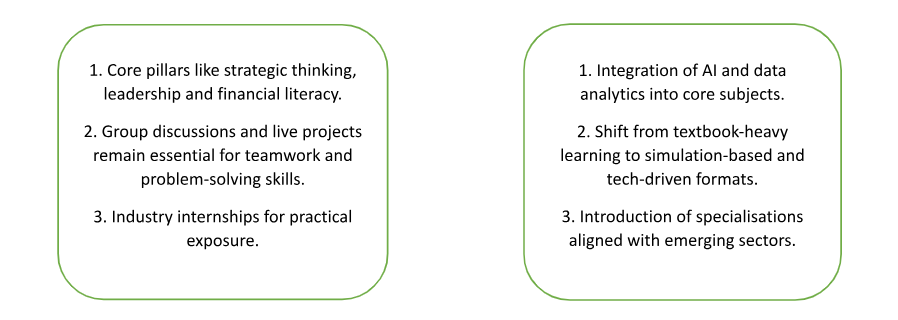
The Shift in Core Learning Formats
Today, learning has become quite different. Now, students are no longer just flipping the heavy textbooks. Here is what learning involves:
-
AI-powered tools that create real environments for students to do decision-making
-
Different groups of students from various specialisations solve interdisciplinary problems together
-
Personalised learning paths for students to tailor their MBA journey to specific interests
-
New learning formats include case-based learning, smart classroom learning and experiential workshops
These changes offer different learning styles, which make business education more accessible and industry-relevant for students.
New Subjects You Won’t Find in the Old Syllabus
You will not find the same MBA subject list in the first year. Here are the future-focused additions you won’t find in the old syllabus:
|
Traditional Subjects |
Modern Additions |
|
Operations Management |
Business Analytics |
|
Human Resource Management |
Leadership & Organisational Effectiveness with simulations & analytics |
|
Marketing Management |
Digital Marketing & Social Media Strategy |
|
Financial Management |
Banking & Financial Services—blending traditional finance with digital tools |
|
Strategic Management |
Strategic decision-making using technology |
These modern additions allow students to meet the emerging needs of today’s world.
New MBA Value Proposition
John C. Maxwell said, “A leader is one who knows the way, goes the way, and shows the way.”
The MBA programme provides a platform that equips students to:
-
Think critically in ambiguous and fast-changing environments
-
Combine technology with strategic insights
-
Develop leadership with ethics, empathy and innovation
MBA programmes prepare students to lead digital transformation, build inclusive teams and navigate sustainability challenges.
Hidden MBA Opportunities Most Students Miss
Mostly, students heavily focus on placements and miss the hidden gems integrated into their MBA programmes. Here are some MBA opportunities students often ignore:
-
Thesis and research projects help students to publish and build subject authority
-
Cross-functional collaborations allow students to work with various peers from finance, marketing and analytics
-
Access to start-up incubators where students pitch, prototype and scale real ventures
-
Dual specialisation, where students can choose subjects and create a unique MBA journey path
These opportunities will help students build an impactful career.
A Strategic Framework for Prospective Students
It’s crucial for every student to check these four questions before enrolling in an MBA programme. Here are the four questions to ask:
-
Does the curriculum include AI, analytics and real-world simulation?
-
Are there flexible electives to build niche skills?
-
Can I access interdisciplinary or industry-linked projects during the programme?
-
Does the programme prepare me for leadership beyond my first job?
Finding the answers to all questions allows you to know whether an MBA programme aligns with tomorrow’s workforce demands.
Experience Future-Ready MBA Programme @ M. S. Ramaiah University of Applied Sciences
Business education is not about memorising textbooks; it is about mastering how to think, lead and adapt in a tech-driven world. The Faculty of Management and Commerce at Ramaiah University of Applied Sciences provides a comprehensive MBA programme designed to empower students with critical thinking and practical training.
Let’s understand the future-ready approach of Ramaiah University of Applied Sciences:
-
Classroom learning with simulations, live case analysis and projects that mirror real business situations
-
MBA subject list in the first year covers the business fundamentals but layers them with digital-age relevance
-
Specialisations that align with the world, including Marketing Management, Human Resource Management, Operations Management, Financial Management, Business Analytics, Hospitality Management and Pharma Business Management
-
Students engage in structured industry projects, internships and publish research
-
Provide a platform for innovation and entrepreneurship
If you want to build a future-proof career, choosing this kind of approach is worth considering.
Conclusion: Choose Forward, Not Familiar
The MBA programme is not all about attending lectures and memorising textbooks. The programme has become a dynamic and ever-evolving platform that highlights real-world complexities. If you are considering an MBA, it is essential to check if a programme helps you lead in a world shaped by AI, ethics and innovation.
In a world where MBA programmes are still stuck in the past, this is where Ramaiah University of Applied Sciences works continuously to design the curriculum around tomorrow’s skills, tools and challenges. So, enrol in the MBA Programme today and lead the future of business!
FAQs
Q1: What are the hidden MBA opportunities students miss?
Some hidden MBA opportunities are thesis and research projects, cross-functional collaborations, access to start-up incubators and specialisation flexibility
Q2: What new subjects will I study in the MBA programme?
You will study traditional subjects with modern additions such as business analytics, digital marketing, etc., according to today’s tech-driven world
Q3: How is the MBA subject list in the first year structured?
In the first year, students study core subjects like marketing management, financial reporting, organisational behaviour, operations, business communication and analytics.


 ADDRESS
