
Happening
Five-Day Faculty Development Programme on “Road Safety Literacy”
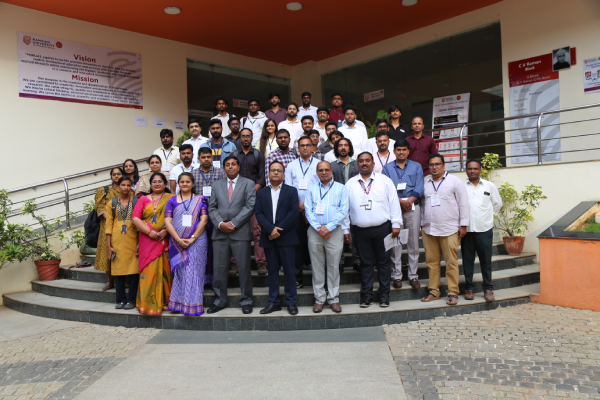
The Department of Civil Engineering, Ramaiah University of Applied Sciences (RUAS), in association with the IISc Sustainable Transportation Laboratory (IST Lab), Indian Institute of Science, Bengaluru, successfully organized a five-day Faculty Development Programme (FDP) titled "From Awareness to Action: Integrating Road Safety Literacy for a Responsible Future" from 27 to 31 July 2026 at the Ramaiah Technological Campus, Peenya, Bengaluru. The programme brought together faculty members, researchers, students, government officials, and industry professionals from across the country to promote knowledge sharing, capacity building, and collaborative initiatives aimed at strengthening road safety education and practice in India.
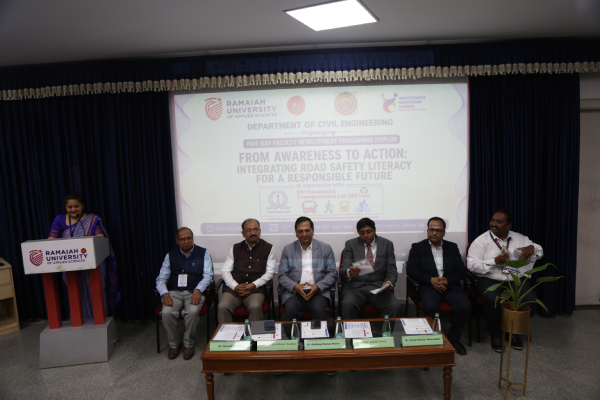
The inaugural session was graced by Prof. Kuldeep Kumar Raina, Hon'ble Vice Chancellor, RUAS, as the Chief Patron. The distinguished guests included Shri Venkata Subbarao Chunduru, Director, Arcadis IBI Group; Prof. Ashish Verma, Convenor, Sustainable Transportation Laboratory (IST Lab), IISc Bengaluru; Dr. Sarat Kumar Maharana, Dean, Faculty of Engineering and Technology, RUAS; Dr. Harshad Rameshwar Parate, Head, Department of Civil Engineering, RUAS; and Dr. Nikhil T. R., Convenor of the FDP. The dignitaries highlighted the importance of integrating engineering education, research, innovation, and multi-stakeholder collaboration to develop safer and more sustainable transportation systems.
One of the major highlights of the programme was the demonstration of Road Safe Twin, an innovative digital twin platform developed by the Faculty of Engineering and Technology, RUAS. The platform integrates Artificial Intelligence (AI), Internet of Things (IoT), Geographic Information Systems (GIS), Computer Vision, Traffic Simulation, and Digital Human Behaviour Modelling to predict road safety risks, analyse traffic behaviour, and support evidence-based decision-making. The prototype received widespread appreciation from academicians, industry experts, and participants for its practical relevance and potential to transform road safety planning and management.
During the five-day programme, participants attended expert sessions on road safety engineering, driver behaviour, Intelligent Transportation Systems (ITS), vulnerable road user safety, accident hotspot identification, road safety audits, black spot treatment, forensic aspects of road traffic crashes, emergency response systems, and national road safety policies. The FDP also featured practical demonstrations, panel discussions, interactive sessions, and hands-on training that effectively bridged the gap between theoretical concepts and real-world applications.
As part of the experiential learning component, participants undertook academic and field visits to the Sustainable Transportation Laboratory (IST Lab), IISc Bengaluru, the Bengaluru Traffic Management Centre (BTMC), and the Traffic Museum. These visits provided valuable insights into advanced transportation research, intelligent traffic management systems, and contemporary road safety practices, emphasizing the significance of interdisciplinary collaboration and data-driven decision-making.
The programme concluded with a valedictory session that celebrated the enthusiastic participation of delegates and acknowledged the contributions of resource persons, industry experts, and collaborating organizations. The successful completion of the FDP reaffirmed RUAS's commitment to advancing road safety education, research, innovation, and institutional collaboration. The programme served as an effective platform for knowledge exchange and professional networking, empowering educators and practitioners to contribute towards building safer roads and fostering a culture of responsible mobility.


 ADDRESS
